Summary: in this tutorial, you’ll learn about the C data types, including basic types, derived types, enumeration, and void.
Introduction to the C data types #
In C, an object refers to a memory location where its content represents a value. If you assign an object a name, that object becomes a variable.
A data type determines the number of bytes allocated to a variable and valid operations that you can perform.
C provides the basic types, derived types, enumeration types, and void:
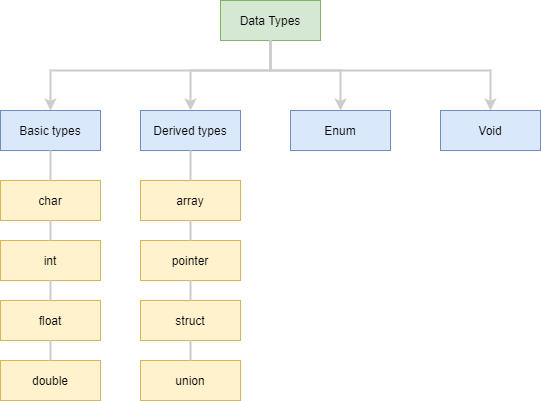
Note that this tutorial provides you with an overview of C data types. And you’ll learn each of them in detail in the following tutorials. It’s fine if you don’t understand fully.
Basic types in C #
C has some basic types:
char– a single byte that can hold one character.int– integer type.float– single-precision floating-point type.double– double-precision floating-point type.
char #
The char type can hold a single character. To form a literal character, you use the single quotes ('). For example:
char ch = 'A';int #
To represent the integers, C uses the int keyword:
int n = 100;C has some qualifiers that can apply to the integers. For example, you can use the short and long qualifiers for integers like this:
short int quantity;
long int counter;The short and long qualifiers change the sizes of integers. The int keyword can be omitted in the declaration:
short quantity;
long counter;The signed and unsigned qualifiers may be applied to integers. The unsigned numbers are always zero or positive:
unsigned int quantity; // quantity cannot be negativefloat #
The float type stores a single-precision floating-point number:
float pi = 3.14;double #
The double type stores a double-precision floating point number:
double price = 9.99;Typically, the number of bytes of a double is as twice the number of bytes of a float.
Boolean #
C doesn’t support the Boolean type natively. Instead, it uses integers to represent boolean values. All non-zero numbers are true while zero is false.
To make it more convenient to work with boolean values, C defines the bool and a pair of constants true and false in the stdbool.h standard library. For example:
#include <stdio.h>
#include <stdbool.h>
int main()
{
bool active = false,
status = true;
return 0;
}Derived types #
The derived types in C are arrays, pointers, struct, and union.
Array #
An array is a list of elements with the same type. For example, you can have an array of integers:
int numbers[] = {1, 2, 3};Pointer #
A pointer is a variable that stores the address of another variable. Suppose, you have a variable n:
int n = 0;The address of n is &n. To define a pointer that stores the address of n, you use the indirection operator (*):
int *pn = &n;By using the pointer, you can manipulate the variable n indirectly. For example, you can assign a value to n by using the pointer like this:
*pn = 10;The value of n now is 10.
Struct #
A struct can contain multiple variables of different types. For example, you can define a struct person that has the first_name, last_name, and age:
struct person
{
char first_name[25];
char last_name[25];
unsigned age;
}Enum type #
Enumeration is a list of named integer constants. The following example defines a list of statuses: open, assigned, and fixed. They correspond to the integer 1, 2, and 3.
enum STATUS
{
open = 1,
assigned = 2,
fixed = 3
};
enum STATUS bug_status = open;void #
The void is an empty type. When a function doesn’t return any value, you can use the void type. For example:
void say(char* something);Summary #
- The basic types in C are char,
int,float, anddouble. - C uses integers to represent boolean values. Nonzero numbers are
true, while zero isfalse. - Derived types include array, pointer, struct, and union.
- An enumeration is a list of named integer constants.
- The void type is an empty type.
Thank you for your feedback!